
Your Ultimate Guide to Hernia Surgery: Everything You Need to Know as a Patient
Hi everyone, welcome back! I assume you are either looking to find out about hernia repair, and/or you may somehow be involved with someone who has just been diagnosed with a hernia and is about to undergo surgery to have it repaired. As a medical professional with extensive experience helping many hundreds of patients through this specific procedure, I will clarify this process for you in the simplest terms possible. We will have a discussion just like you would if you were in my clinic, having a cup of tea with me; so I’m going to use the same terminology and explain this as simply as possible. Though hernias are common and occur in many individuals, they may often develop after a person exerts a strain on their body because of some type of everyday activity, such as lifting grocery bags, prolonged coughing due to an illness, or hunching from pregnancy. Fortunately, when the hernia is repaired by a specialized surgeon performing surgery, the success rate is extremely high, and your active lifestyle will return without any pain or limitations to perform daily activities. In today’s blog post, we will provide you with some in-depth information on the whole process of diagnosing and treating hernias. You will find out everything about different types of hernias for men and women, possible treatments of hernia, and the methods of healing that can realistically be achieved during your treatment period. By following all of the advice your physician provides you with, you will definitely feel much more confident and relaxed when faced with hernia-related problems. Let’s start with our topic!
What Exactly Is a Hernia? The Basics Unpacked
As you consider the abdominal area, it is possible to think about the muscles as the canvas of a tent, which keeps everything tied together inside of it. When a hernia takes place, it can be considered to happen due to a tear in this “canvas” made of muscles, leading to the intrusion of some tissues inside your body, such as portions of your intestinal system, some fats, or even parts of your bladder. In many cases, the hernia is capable of damaging your tissues. If a blood supply is cut off, this can result in a medical emergency called strangulation, where blood is restricted from getting to the affected area, causing tissue damage or death. Why do hernias occur? Several factors contribute to the development of a hernia including; areas of congenital weakness (a soft area that you were born with), thinning of the abdominal muscle due to aging, increased pressure in the abdominal cavity due to obesity, lifting heavy objects without good core strength, chronic coughing due to smoking or allergies and/or straining from constipation, and/or previous surgical incisions with healed scars that healed weaker than originally. Initially, symptoms will be mild and include a vague ache in the belly/groin area that will become worse with activity. As time goes on, symptoms can progress to include: sharp pain, increased swelling, or a bulge that cannot be pushed back into place. If you have any of these symptoms, don’t be a hero; see a doctor quickly for an examination and possibly an ultrasound to confirm the diagnosis. Quick diagnosis is your best friend.
Expanding on that, hernias aren’t picky about age or gender, though patterns emerge. Newborns can have them from incomplete muscle closure in the womb, while seniors face higher risks from decades of wear and tear. In my practice, I’ve seen everyone from gym buffs who overdid deadlifts to new moms whose bodies are still recovering from childbirth miracles. The key takeaway? It’s not a sign of weakness—it’s mechanics failing under pressure—and surgery is the reliable reset button.
Diving Deep into Hernia Types: Which One’s Yours?
Not all hernias are created equal; each type has its favorite hiding spot, risk level, and treatment vibe. Let’s break them down one by one, so you can visualize exactly what’s going on in your body.
Start with the king of the hill: the inguinal hernia. This bad boy accounts for about 75% of all cases and loves crashing the party in the groin area, specifically through the inguinal canal—a passage meant for sperm ducts in men and ligaments in women. In guys, it often feels like a heavy sack in the scrotum; in ladies, more of a deep pelvic twinge. Direct inguinal ones push straight through weakened lower abdominal walls, while indirect ones slip down from the top alongside those ducts. I’ve repaired countless of these—patients tell me it starts as a minor nuisance after yard work but grows into a daily drag.
Then there’s the femoral hernia, a sneakier cousin that slips into the upper thigh just below the groin, near where your femoral artery pulses. It’s rarer (3-5% of hernias) but more dangerous, especially for women post-pregnancy or those with higher BMIs, because the neck of this hernia is narrow, easily strangling contents. Symptoms? A lump low in the thigh that aches when walking, sometimes with thigh numbness. Emergency surgery is common here—no ifs or buts.
Don’t overlook the umbilical hernia, right at your belly button, where we all had that natural weak spot as babies. In kids, it often closes by age 4, but adults get it from obesity, pregnancies, or liver issues, causing fluid buildup (ascites). The bulge pops out when you laugh or lift, and while small ones might just be annoying, larger ones risk incarceration.
Incisional hernia is the payback for all the previous operations one may have undergone. Incisional hernias tend to occur several months after having had any abdominal surgery, such as the removal of an appendix or undergoing a cesarean delivery, as these may be vulnerable to certain complications due to various reasons.
Up top, the hiatal hernia plays by different rules: your stomach’s upper part slides through the diaphragm’s esophageal hiatus into your chest cavity. No external bulge here—instead, you battle acid reflux, chest pain mimicking heart issues, or trouble swallowing. It’s super common in folks over 50, worsened by obesity or smoking, and often pairs with GERD.
Rarer stars include epigastric hernias (between the belly button and the breastbone, from the linea alba strain), spigelian (the side of the rectus muscles, hard to detect), and parastomal (around the ostomy sites). Each has quirks, but the big five cover 95% of cases. Your surgeon will pinpoint yours via physical exam or imaging—knowledge is power!
Spotting Symptoms: Your Body’s Red Flags
Your body will tell you something before screaming out loud; pay attention to your body. General: a soft and squishy mass which enlarges more when standing or straining (coughing, sneezing, bearing down). There may be pain varying from a dull ache to sharp pain with activities. The good news is that if you can reduce it (the lump), it’s okay compared to an irreducible one, which may present nausea, vomiting, and a change in bowel habits. Symptoms pointing toward emergencies are sudden, severe pain, erythema, fever, and inability to pass gas/stool – strangulation or obstruction requiring immediate surgery. Hiatal: dysphagia after eating, reflux, dyspnea.
Treatment Roadmap: From Watchful Waiting to Scalpel Time
However, not all cases of hernias require immediate operation; for instance, small and painless inguinal hernias can be managed by observation in men above 65 years old. Start with basic management by losing excess weight by 5% to 10% of the total body weight, a high-fiber diet of 30 grams per day for soft bowel movements, Pilates exercises (avoid doing crunches), treat any form of cough, and brace appropriately when lifting during work.
But if pain interferes with life, bulge grows, or you’re active, surgery’s the cure—definitive, with recurrence under 5% when done right. Watchful waiting risks emergency ops, which are tougher on you. Let’s explore those surgical superstars.
Open Hernia Repair: The Tried-and-True Classic
A single incision of 3 to 6 inches is made over the hernia. The surgeon uses local anesthesia, spinal anesthesia, or general anesthesia to dissect, scoop out the bulging contents, and reinforce the hole or defect. Pure tissue repair (with sutures only) is done on small hernias only, and 90% of all hernia repairs use mesh. Mesh is a synthetic mesh (polypropylene or biologic options to use in contaminated situations) that is either sewn or tacked into place in order to allow for tension-free healing. There are many advantages to using mesh. Some of the advantages are clear vision, the ability to repair large hernias or to repair previously repaired hernias, and reduced time in the operating room (45 to 90 minutes) compared to the time required for pure tissue repairs. Disadvantages include increased initial pain after surgery and a visible scar that fades to a thin line over time. Most procedures are performed as outpatient procedures with patients having an evening to recover at home, including taking pain medications and using ice packs. I have performed thousands of these procedures, and my patients appreciate the “set it and forget it” long-term results.
Laparoscopic Hernia Surgery: Keyhole Precision
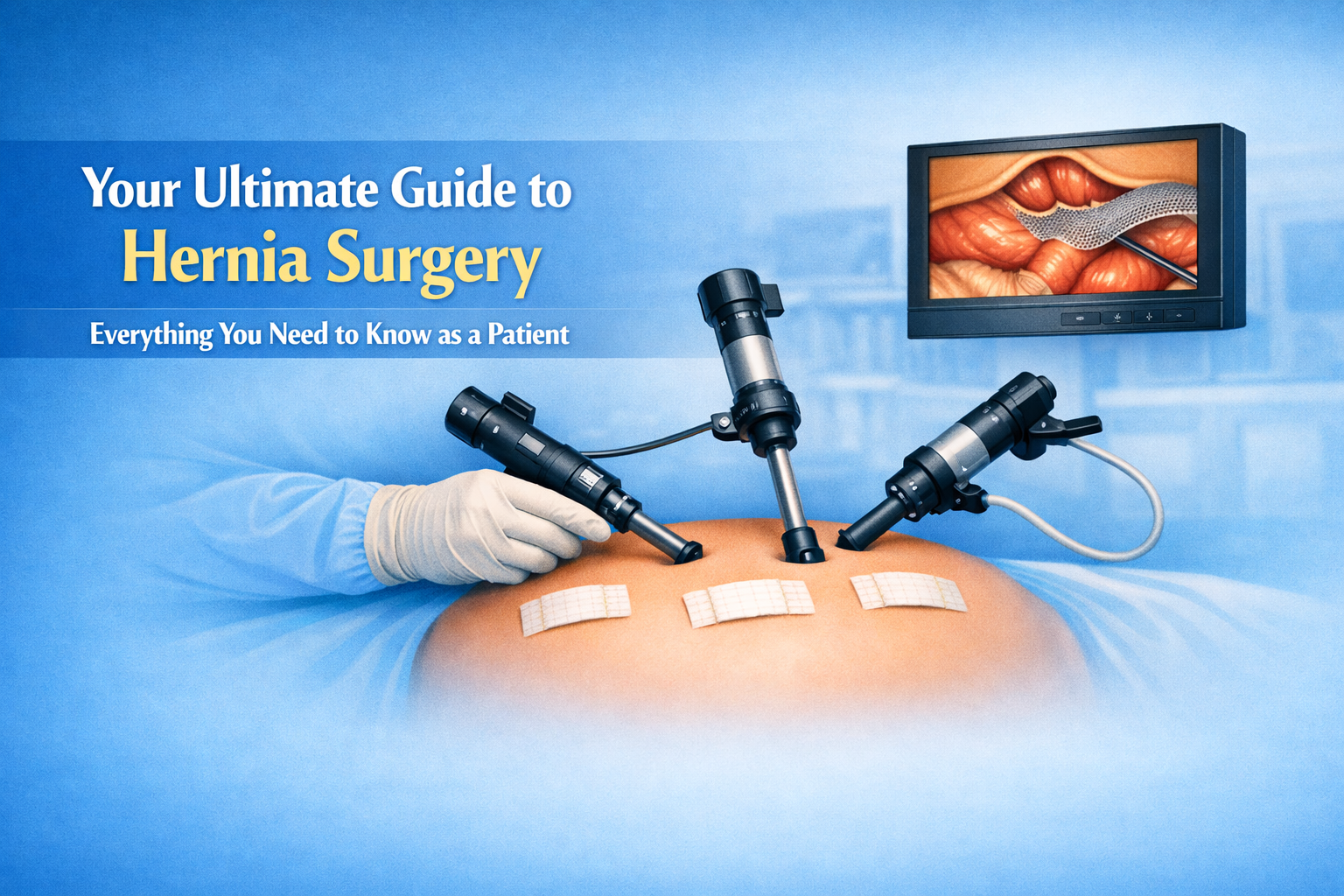
Using technology to help! Three to five small ports (1/2 inch), one for the camera, the other for graspers, staplers, and CO2 gas inflates (puff) the abdomen up like a balloon for space for a surgeon to work. From the abdomen, the peritoneum (lining of the abdomen) is peeled off, the hernia is flattened, the mesh is rolled out over the area of the hernia, and secured with tacks or glue. TAPP (transabdominal preperitoneal) or TEP (totally extraperitoneal) techniques ensure the mesh does not touch the intestines. Surgery is done under general anesthesia (30-60 minutes). There are many advantages to this type of surgery: 50% reduction in pain, recovery time cut in half, small size of scars for cosmetic reasons, very low risk of infection, ideal if suffering from a bilateral hernia. However, this type of repair is not suitable for everyone, as morbidly obese individuals or individuals who have had prior surgeries in the abdominal area can create difficulty in the repair. For me, this procedure has proven to be the best advancement in hernia repairs for healthy individuals.
Robotic Hernia Repair: The High-Tech Edge
The da Vinci system elevates laparoscopy: the surgeon at a console, controlling 3D-HD robot arms with wristed precision. Same ports, but shaky hands? Gone. Tremor-filtered, deep-field views make suturing a breeze, bleeding minimal. Setup adds 20 minutes, costlier (insurance often covers), but outcomes shine for complex ventral/incisional repairs or obese patients. Studies show even shorter stays and less opioids. If available, it’s worth asking—future of hernia care.
Mesh deep dive: flat sheets, 3D plugs, or self-gripping evolve yearly. Allergies? Absorbable or animal-derived options exist. Infection worry? Coated meshes with antibiotics.
Prepping Like a Pro: Your Surgery Day Blueprint
Two weeks out: full history, bloods (CBC, coags), EKG if cardiac history, chest X-ray, maybe CT/MRI for planning. Quit smoking (lungs heal better), pause NSAIDs/aspirin 7 days, stock fiber/softeners/laxatives. Night before: clear liquids till midnight, antiseptic shower. Day of: NPO after midnight, loose clothes, designated driver. OR: IV line, monitors, anesthesia chat (risks like nausea 20%, breathing issues rare). Family waits comfortably. Post: PACU hour for stability, then discharge criteria met.
Inside the Operating Room: A Surgeon ‘s-Eye View
Anesthesia flows—you drift off. Site prepped sterile. Incisions precise. For open: retractors hold the field, hernia sac opened/dissected free, contents reduced safely (bowel viable?). Defect measured, mesh trimmed/fitted, and fixed circumferentially. Close in layers: peritoneum if needed, muscle fascia, skin with absorbables or glue. Lap/robotic: trocars in, scope lights the cavity, peritoneum incised like peeling a banana, space created, mesh parachuted in, rolled flat, fixed—no holes. Hemostasis checked, desufflate, ports out, dress minimally. Band-Aids basically.
Recovery Decoded: Day-by-Day, Week-by-Week Wisdom
First 24-48 hours: ouch factor peaks, but Tylenol + ibuprofen duo often enough; narcotics if brutal. Ice 20/20, elevate, tiny sips to water, advance slow (broth, crackers). Walk laps hourly—clot prevention gold. No baths, driving, or >5-10lb lifts. Day 3: shower bliss, fatigue normal from anesthesia.
Week 1 milestone: staples/sutures out if open, wound pristine? Good. Light errands OK, but nap often—body’s rebuilding collagen. Constipation foe? Miralax + prunes.
Weeks 2-3: desk warriors return, drive if twisting painless. 20-30min walks daily ramp VO2. Stairs are fine, no core blasts. Pain? Fading echo.
Month 1-2: gym lite (bike, swim post-clearance), lift 50% max at 6 weeks, full throttle 8-12. Scar massage with vitamin E oil monthly. Follow-ups: 1 week wound, 6 weeks functional, 1 year scar.
Open takes longer (4-6 weeks full), laps/robotic 2-4. Smokers, diabetics, obese? Add 1-2 weeks. Track progress; call if off-script.
Everyday Post-Op Hacks for Smooth Sailing
Wound warriors: inspect daily, warm soapy wash, pat dry, breathable dressings. Red/hot/pus/fever>100.4? Antibiotics stat (1-2% risk). Pain pyramid: meds, heat/ice alternate, distraction (podcasts). Bowels: hydrate 2-3L, fiber bomb (oats, veggies), walk. Gas pain? Simethicone, knees-to-chest. Sleep propped. Sex? When comfy, lube up (2-4 weeks). Work: sedentary 3-7 days, manual 4-6 weeks. Kids/pets? Enlist help in week 1.
Diet evolution: anti-inflammatory—salmon, berries, nuts. Avoid bloating culprits early (beans, soda). Supplements? Protein shakes for healing, vitamin C/zinc if cleared.
Potential Hiccups: Risks, Red Flags, and Real Talk
99% smooth, but honest time: infection (1-3%, higher open), hematoma/seroma (fluid pockets, drain or aspirate), urinary retention (catheter rare), orchitis (testicle swell guys), bowel injury (<0.5%). Mesh? Erosion is super rare (0.1%), and pain syndromes 1-5% resolve with time/injections. Recurrence 1-3% mesh vs. 10-15% pure tissue. Anesthesia: sore throat, DVT prophylaxis with early ambulation. Your risks? Surgeon crunches based on BMI and comorbidities. Emergencies: unrelenting pain/vomitus/bulge return—ER.
When to Jump on Surgery: Timing Is Everything
Watch if asymptomatic, operate if symptomatic/growing/occupation demands. Kids? Umbilical by 4-5 if persisting. Emergency if strangulated (5% hernias). Elective is calmer, better outcomes.
Thriving Long-Term: Prevention and New You
Post-fix: core like steel—planks, bridges. Lift smart: legs, not back. Weight mastery. Cough control. Annual self-exam. Most rave “wish sooner”—energy soars.
Patient Stories That Inspire
Recall John, 55, trucker with bilateral inguinal: lap repair, back hauling week 3. Maria, post-C-section incisional: robotic, dancing salsa, month 2. Real wins.
Answering Your Burning Questions
Pain scale? 4-6/10 peaks day 2, gone week 2. Scars fade in year 1. Cost? $5-15k US, insurance typical. Same-day home? Yes, 90%. Repeat risk? Minimal.
Wrapping It Up with Heart
Hernia surgery? Routine miracle. You’ve got this—prep, trust your team, heal deliberately. Questions? Drop comments; I’m here. Share if it helped!